
Nobody warned you about Dinesh Soni.
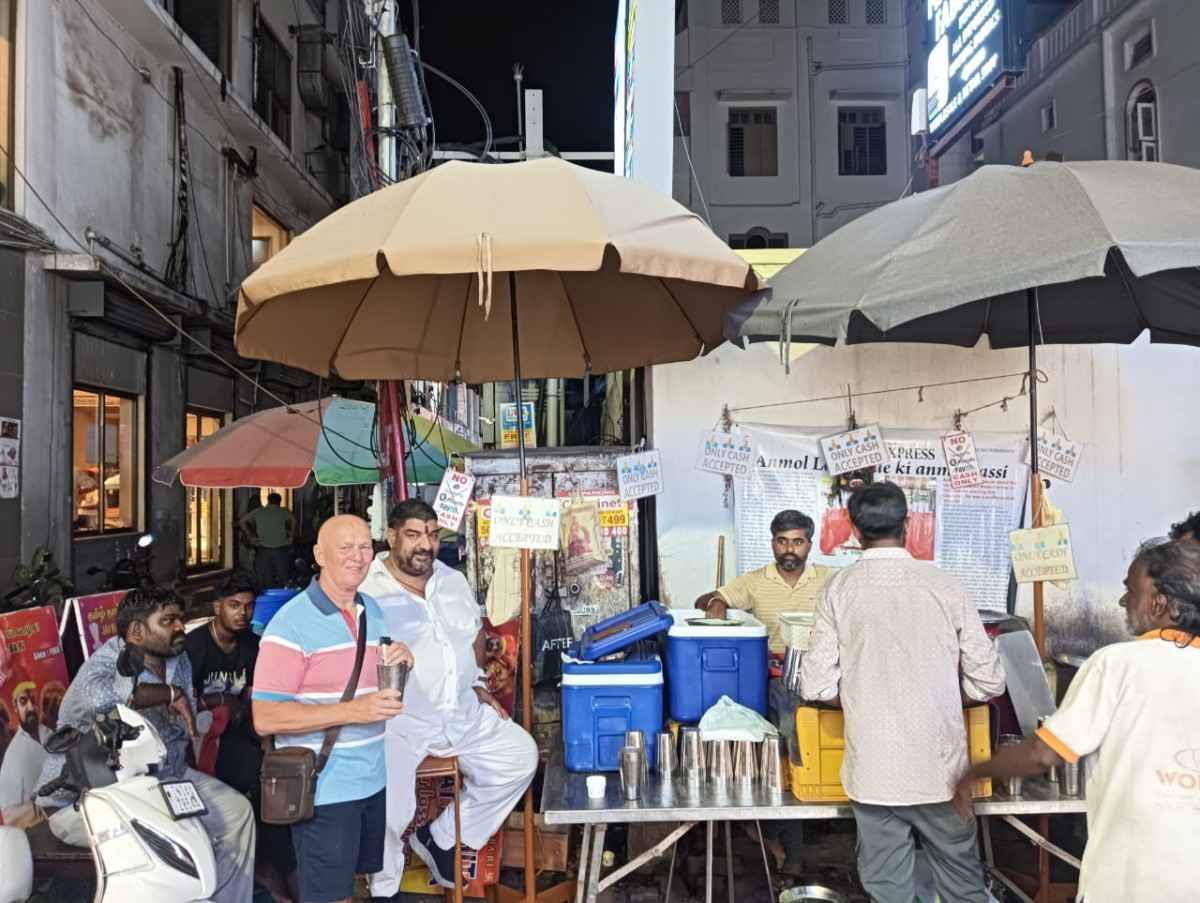
He is not in the guidebooks. His lassi bar does not have a website. TripAdvisor has a few mentions but nothing that does justice to what actually happens when a former professional wrestler decides that his calling in life is to make the finest kesar lassi in Chennai from a street corner on Mint Street, every single evening, for thirty years without interruption.
You will not find him unless someone who knows these lanes takes you there.
And that is the whole point of the Sowcarpet food walk.
Sowcarpet is Chennai’s most surprising neighbourhood. It is a North Indian food enclave in the heart of South India, built by Sindhi and Marwari trading communities who arrived centuries ago, brought their entire culinary tradition with them and proceeded to create something that exists nowhere else on earth. A street where you can eat the finest vada pav outside Mumbai, the most extraordinary jalebis this side of Jaipur and a sandwich made from a South Indian ingredient that nobody outside these lanes has ever thought to use as bread.
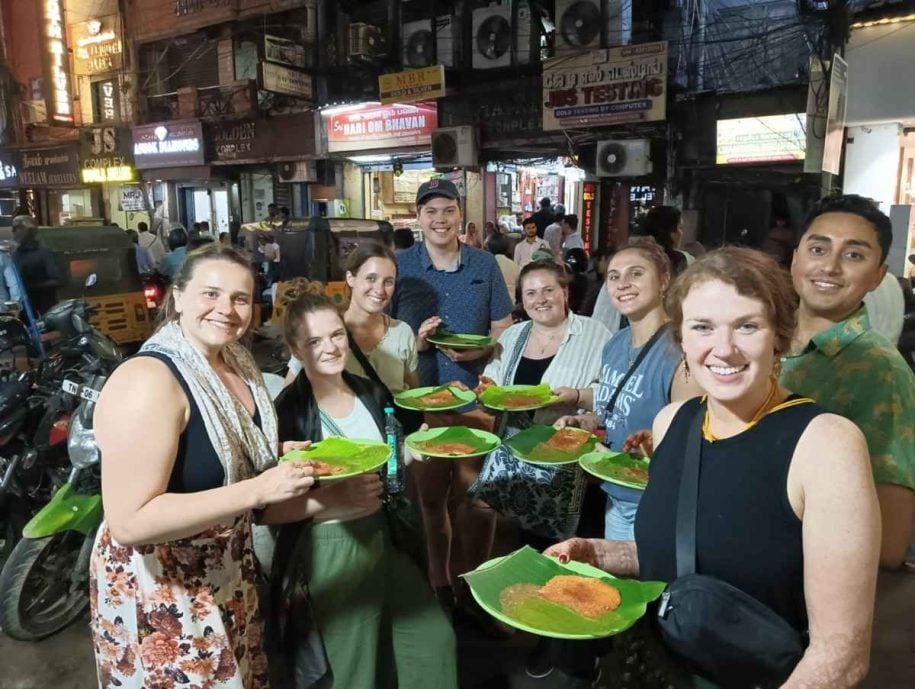
This is not a gentle food walk through a sanitised market. It is an assault on all five senses through one of the most frenetic, characterful and genuinely extraordinary streets in India. The lanes are barely wide enough for two people. Autorickshaws and cows compete for the same narrow space. The air is thick with frying oil, fresh marigolds from the nearby flower bazaar and the sharp perfume of saffron-laced lassi.
And in the middle of all of it, there is Dinesh Soni, former professional wrestler, current keeper of the finest lassi recipe in Tamil Nadu, standing at his corner as he has every evening for three decades.
This is your complete guide to the Sowcarpet food walk with 5 Senses Walks. Every dish. Every story. Every reason why this two-hour walk through the lanes of George Town is one of the most memorable food experiences available anywhere in India.
Sowcarpet Chennai: The Story of the North Indian Food Street That Chennai Forgot to Tell You About
Chennai is the capital of South Indian food culture. The city of idlis, dosas, filter coffee and temple prasadam. Every food guide, every travel blog and every well-meaning local will send you to the same temples of Tamil cuisine and tell you the same stories about the same dishes.
None of them will tell you about Sowcarpet.
How Sindhi and Marwari Traders Built a Culinary World of Their Own in the Heart of South India
Sowcarpet takes its name from Sahukar Pettai, meaning Merchant’s Quarter in Tamil. The name tells you everything you need to know about what this neighbourhood was built to be and by whom.
The Sindhi and Marwari trading communities who settled here centuries ago came to Chennai because the city was one of British India’s greatest commercial ports. The Grand Trunk Road and the sea routes converged here. The money was here. And where the money went, the merchants of Rajasthan and Sindh followed.
They brought more than their business acumen. They brought their entire world with them.
Their temples are here, Sindhi temples with a character entirely unlike the Dravidian temples that define the rest of Chennai. Their wholesale textile markets are here, filling the lanes with bolts of fabric in colours that seem to vibrate in the late afternoon heat. Their language is here, Hindi and Sindhi cutting across the Tamil of the surrounding city like a culinary countermelody.
And their food is here.
The pyaaz kachori of Rajasthan. The vada pav of Maharashtra. The thick sweet lassis of the North. The spiral jalebis fried in clarified butter and soaked immediately in sugar syrup exactly as they have been made in Jaipur and Delhi for centuries. All of it transplanted to a collection of narrow lanes in George Town, Chennai, and kept alive with extraordinary fidelity across generations of a community that never forgot where it came from.
Why Sowcarpet Is the Most Genuinely Surprising Food Experience in Chennai
The surprise of Sowcarpet is the thing that every visitor who has done the food walk mentions first. International travellers from Australia, the USA and the UK consistently describe the experience as completely unlike anything they expected from South India. One Australian couple described it as visiting a completely different country inside the same city. A British traveller said it was like stumbling through a portal from Chennai into Old Delhi without anyone warning her it was going to happen.
This is not an accident. Sowcarpet has been North Indian territory in a South Indian city for centuries and it has never needed to advertise itself to outsiders. The traders who come here come for wholesale goods. The locals who come here come because they grew up eating this food. Nobody comes here by accident from a travel guide because the travel guides do not know it exists.
Until now.
Our Sowcarpet food walk with 5 Senses Walks is led by a cultural food evangelist who has spent years building relationships with the legendary vendors of these lanes. He knows where to go, what to order and most importantly what stories to tell. You will not get lost. You will not order the wrong thing. And you will not leave without having experienced something that most visitors to Chennai never find.
The Dishes on the Sowcarpet Food Walk: The Full Story Behind Every Stop
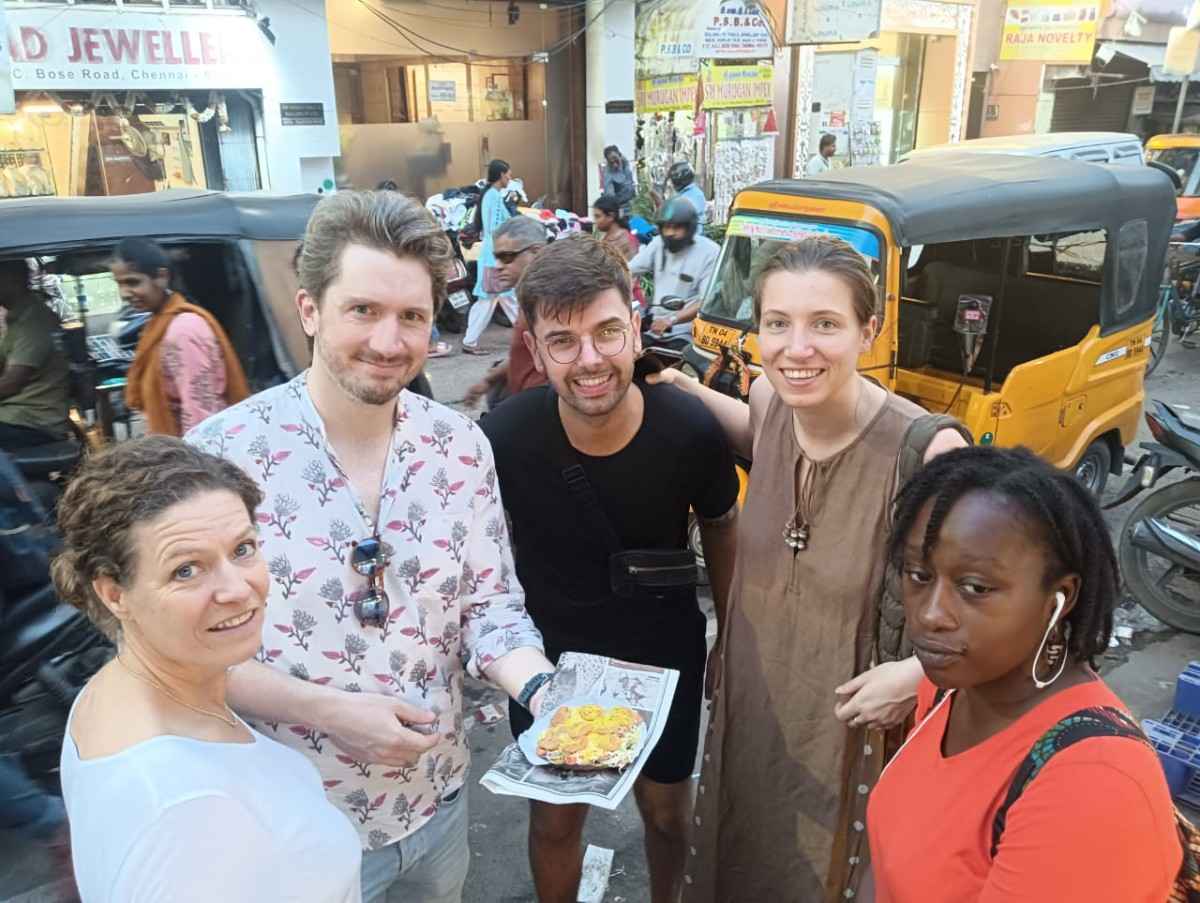
Pyaaz Kachori at Maya Chats: Where the Sowcarpet Food Walk Begins
The walk begins at Maya Chats on Audiappa Naicken Street and the pyaaz kachori here is the perfect opening statement about what Sowcarpet is.
A kachori is a deep-fried pastry from the street food tradition of Rajasthan and Uttar Pradesh. Done badly it is greasy and heavy. Done well, as it is here at Maya Chats, it is one of the great achievements of North Indian street food craft. The pastry shell is shatteringly crisp, formed from dough that has been rolled with extraordinary precision to achieve an even thickness that puffs and blisters in the hot oil without burning. Inside it is a filling of spiced onion and yellow lentils, cooked down until the lentils almost dissolve into the onion, the whole thing seasoned with cumin, coriander and dried mango powder that cuts through the richness with a bright sourness.
It arrives with two chutneys. A tamarind chutney that is sweet and dark and deep. A green coriander and mint chutney that is cold and sharp and vivid. The combination of the hot pastry with the cold chutneys is the kind of pleasure that the North Indian street food tradition has been perfecting for centuries.
That you are eating this in Chennai, in a lane that smells of marigolds and frying oil and sounds like a city waking up for its evening shift, makes it more extraordinary not less.
The Murukku Sandwich: The Dish That Only Exists in Sowcarpet and Nowhere Else on Earth
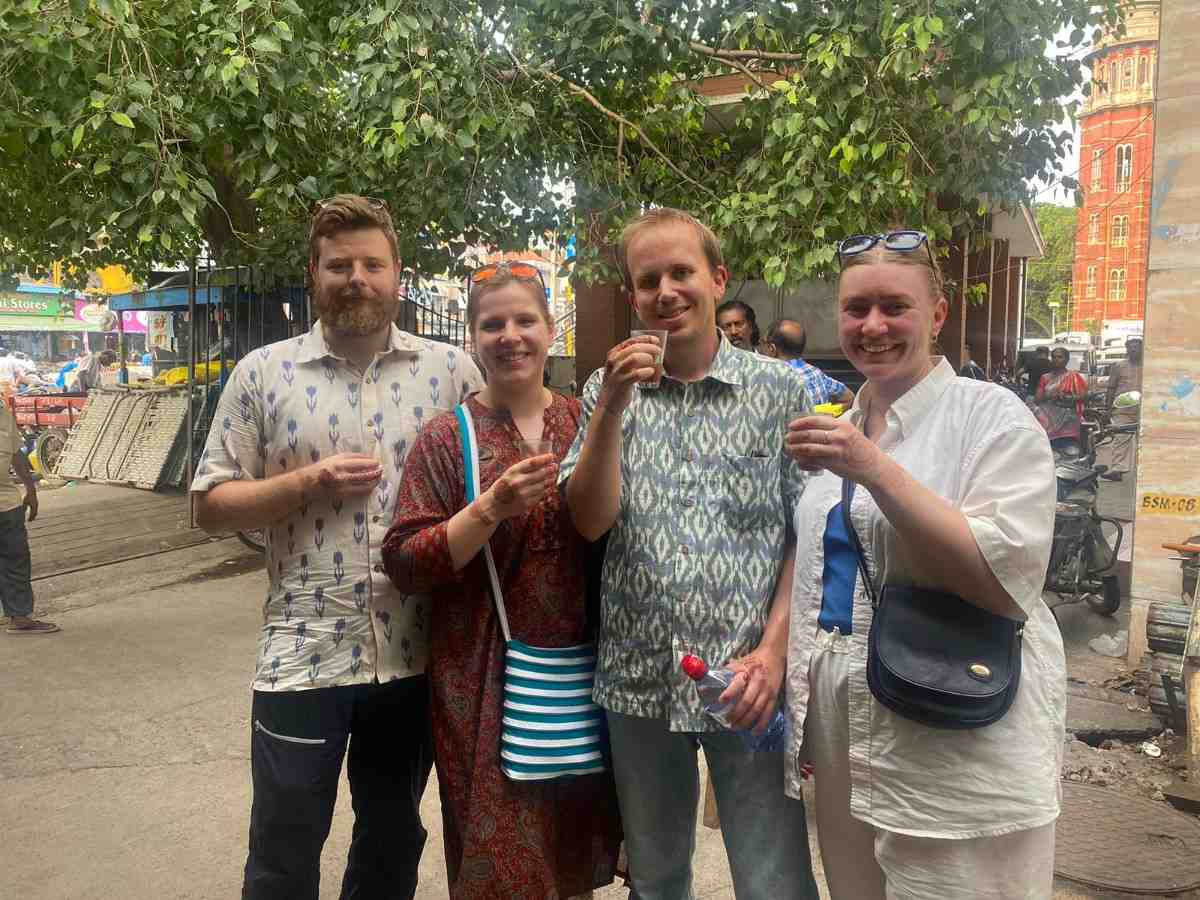
Here is the thing about the murukku sandwich.
Murukku is a South Indian snack. It is made from rice flour and urad dal flour, pressed through a mould into a spiral or star shape and deep-fried until it becomes a crisp, golden, intensely savoury cracker that shatters into a thousand fragments when you bite into it. Every South Indian household knows murukku. Every Tamil grandmother makes murukku for Diwali. It is as South Indian as filter coffee and Kapaleeshwarar Temple.
Nobody in Rajasthan or Maharashtra or Delhi has ever put a filling inside murukku and called it a sandwich.
Nobody except the vendors of Sowcarpet.
At some point in the history of this extraordinary neighbourhood, somebody who grew up eating murukku but grew up in a food culture that understood sandwiches and stuffed pastries and chaat assembled on crispy bases decided that the same principle could apply. That the crunch of murukku was not just a snack in itself but a vessel. A base. A bread made from something that had never been used as bread before.
The result is a sandwich that shatters when you bite into it, filling your mouth simultaneously with the nutty savoury crunch of the murukku and the spiced filling inside it. The textures are completely unlike anything produced by any other sandwich on earth. The flavour combination is simultaneously South Indian and North Indian and entirely its own.
It is the culinary embodiment of Sowcarpet itself. A place where two great food traditions met, respected each other and invented something neither could have created alone.
Vada Pav at Shree Vada Pav: Mumbai’s Greatest Street Food Faithfully Kept in a Chennai Alley
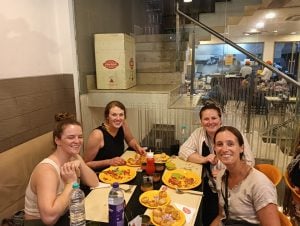
Vada pav is Mumbai. It is the city’s heartbeat, its cheapest pleasure, its most democratic institution. At twelve rupees from a street stall you get a deep-fried spiced potato dumpling, a soft white bread bun, a fierce garlic chutney and a single fried green chilli. Tens of millions of Mumbaikars eat vada pav every day for breakfast, lunch and dinner. It is simultaneously the simplest and the most satisfying thing you can eat in Maharashtra.
Shree Vada Pav on Ramanan Road in Sowcarpet has been faithful to this tradition for decades. The recipe here is Mumbai’s recipe. The dough for the vada is spiced with mustard seeds, curry leaves, turmeric and green chilli. The potato filling is mashed to exactly the right consistency, neither too smooth nor too rough. The bun is soft and slightly sweet as it should be. The garlic chutney is fierce enough to make your eyes water briefly before the pleasure takes over.
The fact that this dish exists here, executed with this level of faithfulness, in a city four hundred kilometres south of the Maharashtra border, speaks to the extraordinary cultural continuity of the communities who built Sowcarpet. They did not adapt the vada pav to South Indian tastes. They did not compromise with local ingredients. They kept it exactly as it was brought from Maharashtra because to change it would be to lose something essential.
When you eat vada pav at Shree Vada Pav in Sowcarpet you are eating something that connects you directly to the street food culture of a city you may never have visited, preserved with complete fidelity in a lane of Chennai by people who understood that some things are worth keeping exactly as they are.
Kesar Lassi at Anmol Lassi: The Most Extraordinary Story on the Sowcarpet Food Walk
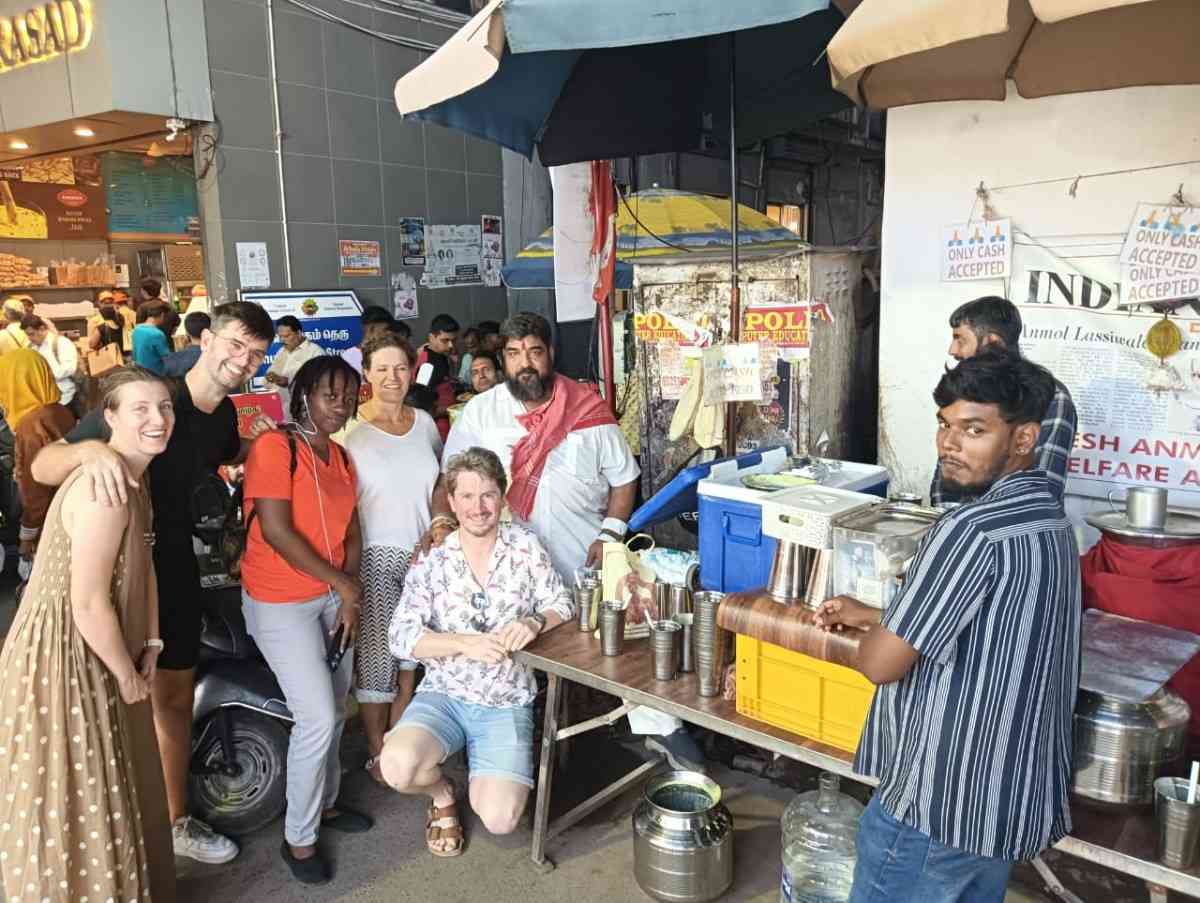
Dinesh Soni was a professional wrestler.
For years he competed in the wrestling circuits of North India, developing the kind of physical strength and competitive ferocity that professional wrestling demands. He was good. Not famous, but good. The wrestling years built him into the kind of man who occupies space with complete authority, who moves through a crowded market lane and somehow the market lane makes room.
And then he stopped wrestling and started making lassi.
Nobody knows exactly why. The story, as our food evangelist tells it on the walk, involves the end of a wrestling career, a family tradition of dairy, and the particular clarity of a man who knows what he is good at and what gives him satisfaction. Dinesh Soni is good at making lassi. It gives him complete satisfaction. And thirty years after he first set up on his corner of Mint Street, he is still there every evening, churning his kesar lassi with the kind of focused intensity that presumably served him well in the wrestling ring.
The lassi itself is extraordinary. It begins with curd that is not sour, selected with the care of someone who has spent three decades understanding exactly what the right curd feels like. It is churned until it achieves a thick, velvet-smooth consistency that is completely unlike the thin, watery lassis that pass for the real thing in most places. Saffron is added, real saffron, the kind that turns the liquid a deep amber gold and perfumes it with a floral warmth that you feel in the back of your throat. Sugar is added carefully, enough to balance the natural tartness of the curd without overwhelming it. A layer of dried cream is floated on top. The glass, enormous and misted with cold, is placed in your hands.
You will drink it standing on Mint Street, in the middle of the evening chaos of Sowcarpet, surrounded by the sounds and smells of one of the most characterful neighbourhoods in India. And you will understand immediately why Dinesh Soni gave up wrestling for this.
Our Sowcarpet food walk with 5 Senses Walks takes you to Anmol Lassi as one of the centrepiece stops. The full story of Dinesh Soni is delivered by your food evangelist at the moment you are standing in front of him, glass in hand, wondering how a former professional wrestler ended up making the finest lassi in Tamil Nadu.
Aloo Tikki at Kakada Ramprasad: The Street Food Predecessor to the Main Event
Before the jalebis there is the aloo tikki. And the aloo tikki at Kakada Ramprasad deserves its own moment.
Aloo tikki is the quiet workhorse of North Indian street food, the dish that never gets the credit it deserves because it is made from ingredients so humble that people forget it takes real skill to make it extraordinary. Potatoes. Spices. Heat. That is the entire ingredient list.
What makes Kakada Ramprasad’s aloo tikki exceptional is the crust. The potato patties are pressed onto the tawa with a weight that forces them flat and thin at the edges, creating a surface area that maximises contact with the hot iron. The exterior becomes a deep mahogany brown, almost lacquered, crackling at the very edges while the centre remains soft and yielding. The spicing inside is restrained, just enough turmeric, cumin and green chilli to make every bite interesting without competing with the tamarind chutney that arrives alongside it in a small stainless steel bowl.
You eat this standing up on the pavement outside Kakada Ramprasad, watching the evening crowd of Sowcarpet move around you, and you understand that you are one of tens of millions of people across North India who have eaten this exact dish in this exact way for as long as anyone can remember. Street food at its most democratic, its most delicious and its most completely satisfying.
Jalebi at Kakada Ramprasad: Sixty Years of the Same Recipe on the Same Corner of Mint Street
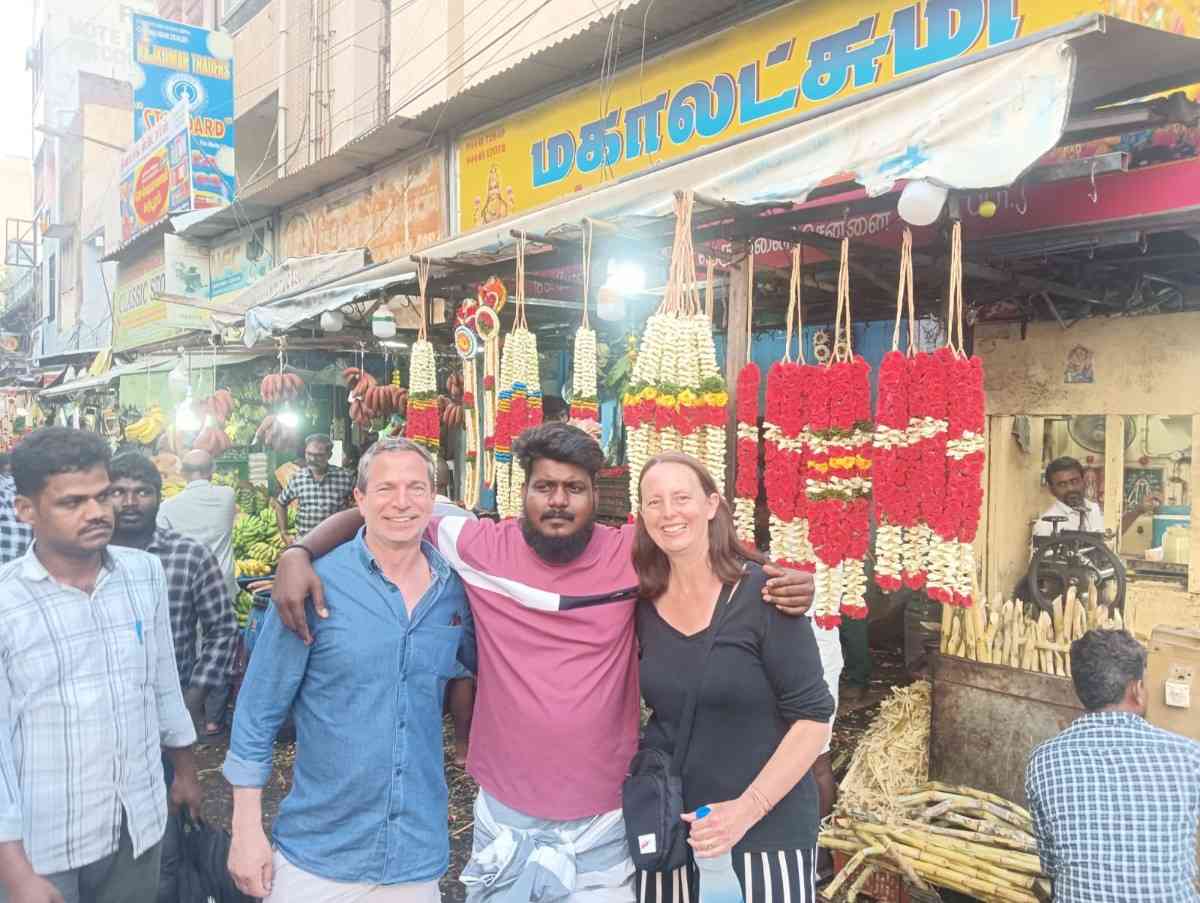
Six decades.
Think about what that means. The jalebi recipe at Kakada Ramprasad on Mint Street has been unchanged since the same years that saw India newly independent, Nehru in power and Chennai still called Madras. Every political transformation India has lived through since then, every economic shift, every generational change in taste and culture and technology, has passed over this corner of Mint Street without disturbing the recipe even slightly.
The batter is made from fermented flour and yogurt and water, mixed to exactly the right consistency by someone who learned from someone who learned from someone who was there at the beginning sixty years ago. It is poured through a cloth with a small hole into hot clarified butter in a continuous spiral motion, the circles overlapping at the centre to create the characteristic double-loop shape that defines a proper jalebi. The frying takes less than two minutes, during which the batter sets into a crisp, lacework structure that is simultaneously delicate and structurally sound.
The jalebi comes out of the oil and goes directly into the sugar syrup. Not stored. Not prepared in advance. Directly from the oil into the syrup, which penetrates every pore of the lacework structure immediately, filling the interior with a liquid sweetness that is entirely contained by the crisp exterior.
The result is a jalebi that is crunchy on the outside and explosively sweet on the inside, warm from the oil, fragrant from the clarified butter and the saffron-tinged syrup, with just enough sourness from the fermented batter to keep the whole thing from being cloying.
This is how a jalebi is supposed to taste. This is the version against which all other jalebis in Chennai should be measured. And it has been available on this corner of Mint Street for sixty years because the Kakada Ramprasad family understood from the beginning that when you have something this good you do not change it.
The Full Sensory Experience of Walking Through Sowcarpet at Dusk
What Happens to Sowcarpet When the Sun Goes Down
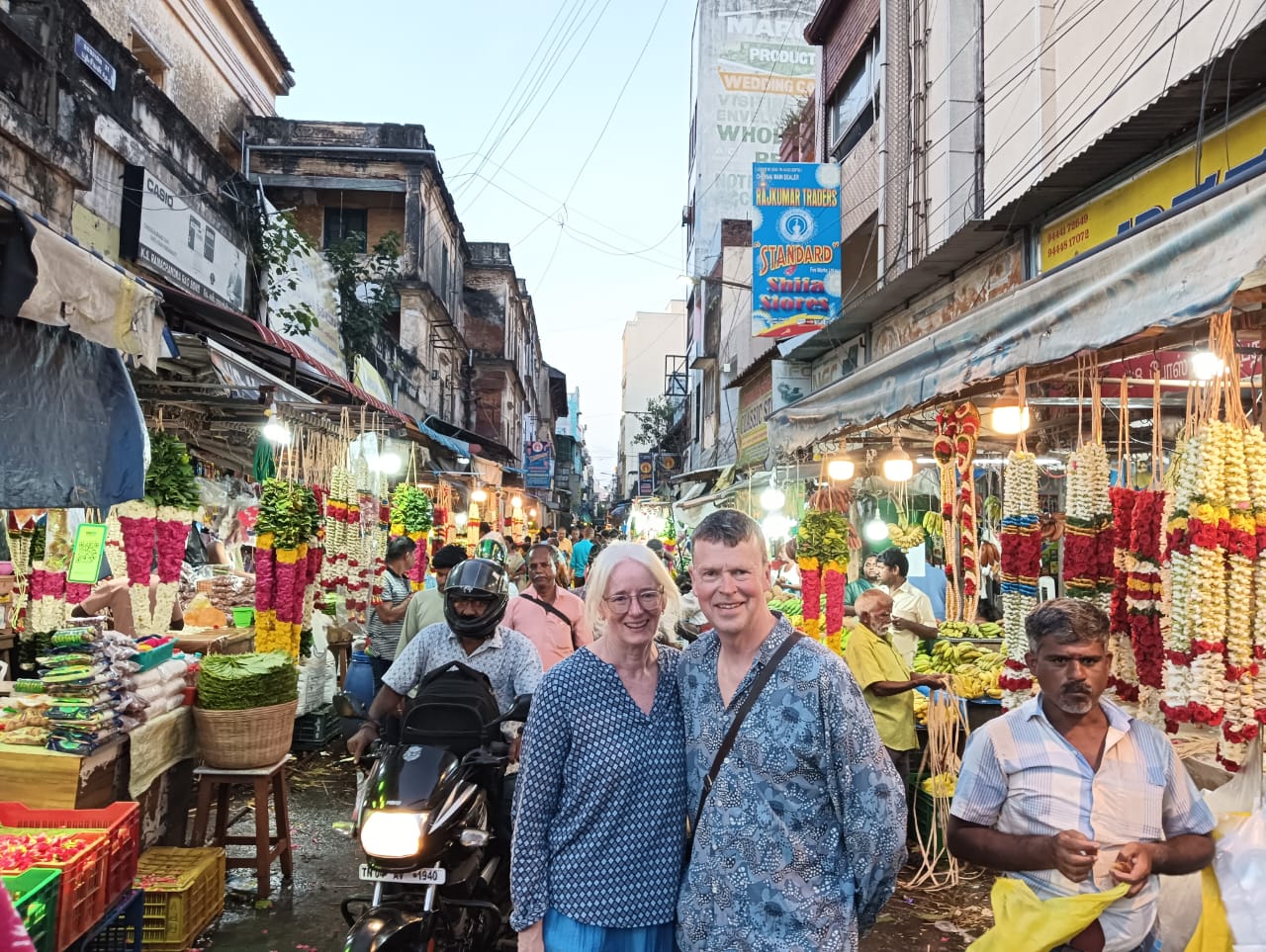
The Sowcarpet food walk begins at 4.30pm because this is the moment when the neighbourhood transforms.
During the day Sowcarpet is a wholesale trading market. The lanes are crowded with buyers and sellers of textiles, plastics, hardware, dry goods and every conceivable category of merchandise. The food stalls are present but peripheral, snack stops for traders and shopkeepers rather than destinations in themselves.
Then the late afternoon arrives and something changes.
The wholesale traffic begins to thin. The shopkeepers pull down their shutters halfway and lean in the doorways. The light shifts from the flat white heat of the Chennai afternoon to the warm amber of early evening. And the food vendors emerge with the confidence of people who know that this time of day belongs to them.
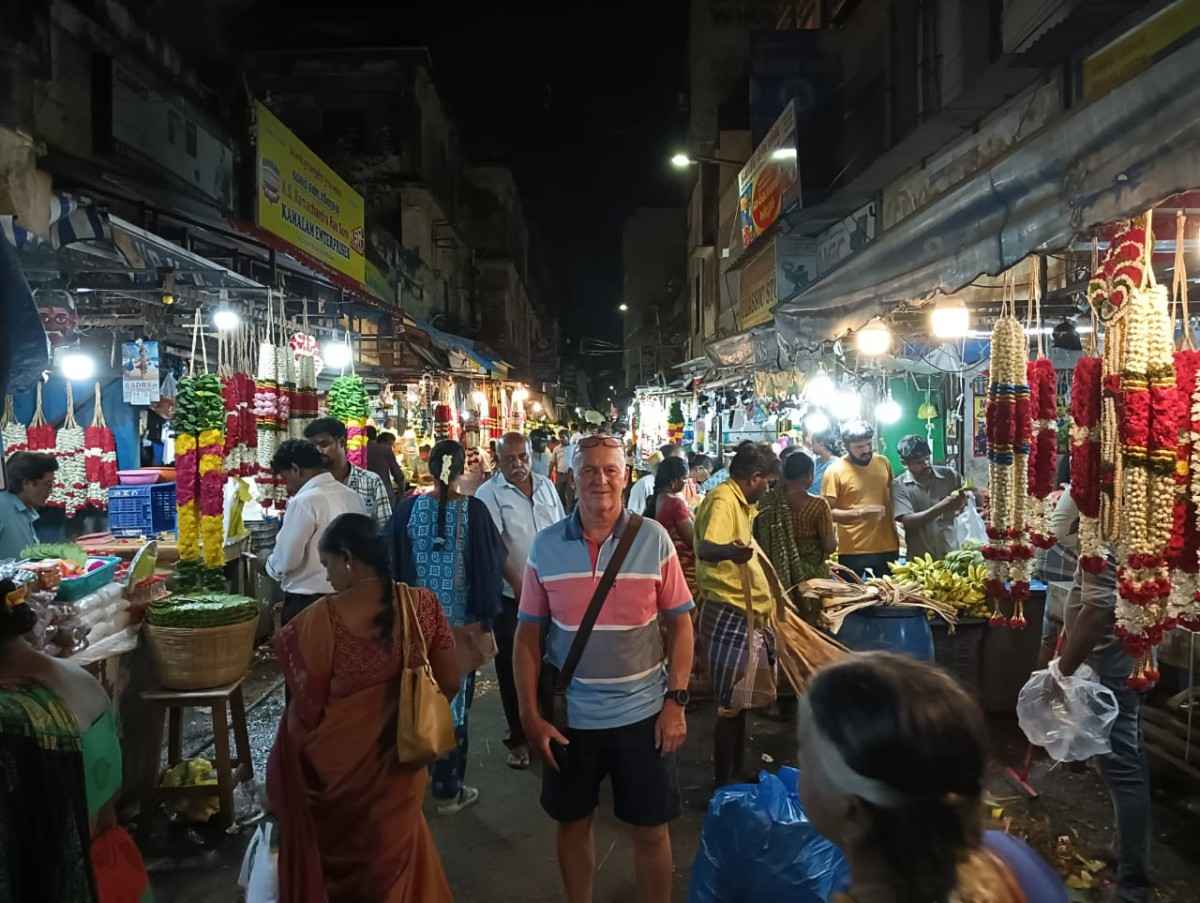
The smell arrives first. Hot oil from a dozen frying pans competing with each other across the narrow lanes. Fresh marigolds from the Flower Bazaar two streets away, so dense and heavy in the air that you can almost taste them. The sharp, bright perfume of saffron lassi from Dinesh Soni’s corner. Tamarind chutney in small steel bowls. Coal smoke from the chai stalls. The sweet caramel note of hot sugar syrup hitting cold metal.
Then the sound. The rhythmic slap of dough being pressed flat. The hiss of batter meeting hot oil. The clatter of steel tumblers. Vendors calling their inventory to the evening crowd in a mixture of Tamil and Hindi that is entirely Sowcarpet’s own linguistic invention. Autorickshaws finding improbable routes through lanes that are not quite wide enough for them. A cow walking through the whole scene with complete indifference to all of it.
Then the colour. The orange and gold of fresh jalebis cooling on steel trays. The yellow of fresh turmeric in open sacks. The crimson of dried chillies in towers by the doorways. The deep amber of Dinesh Soni’s kesar lassi in enormous chilled glasses. The pale gold of aloo tikki crisping on a flat iron tawa over coal. The marigold-yellow, vermilion-red, jasmine-white of flower garlands in the stalls between the food vendors.
You have not started eating yet. Sowcarpet has already given you more than most travel experiences deliver in a full day.
Why You Cannot Do This Walk Without a Guide
We want to be completely honest about this because it matters.
Sowcarpet is not a place you can explore effectively on your own as a first-time visitor.
The lanes are a maze that disorients even regular Chennai visitors. There is no map that accurately reflects the actual layout of the food stalls because they move and change seasonally and the best ones have no signage whatsoever. The vendors do not speak English as a rule and are not oriented toward explaining their food to strangers. The best dishes at the best stalls require knowing specifically what to order because the menu, if one exists at all, is in Tamil or Hindi and lists things by names that mean nothing without context.
And most importantly the stories are invisible without someone who knows them.
You could walk past Dinesh Soni’s lassi bar and see a man with large glasses of yellow drink and think nothing of it. You could eat an aloo tikki at Kakada Ramprasad without knowing that the recipe has been unchanged for sixty years. You could bite into a murukku sandwich and be surprised by the texture without understanding that what you are eating is something that was invented right here in this lane and exists nowhere else on earth.
The stories are what transform the experience from eating street food in a crowded market to a genuine encounter with the living culture and extraordinary characters of one of Chennai’s most unique neighbourhoods.
Our food evangelist on the Sowcarpet food walk with 5 Senses Walks carries these stories as his professional and personal knowledge. He knows Dinesh Soni. He knows the Kakada Ramprasad family. He has walked these lanes hundreds of times and knows exactly where to be at exactly what time to ensure you experience Sowcarpet at its most alive and its most extraordinary.
Come with us. The street rewards it in a way that independent exploration simply cannot match.
Plan Your Sowcarpet Food Walk With 5 Senses Walks: Everything You Need to Know
What Is Included and How to Book
The Sowcarpet food walk with 5 Senses Walks is a two-hour expert guided experience through the most legendary food stops of Sowcarpet’s Mint Street and surrounding lanes, led by a cultural food evangelist with deep personal knowledge of the neighbourhood, its history and its remarkable people.
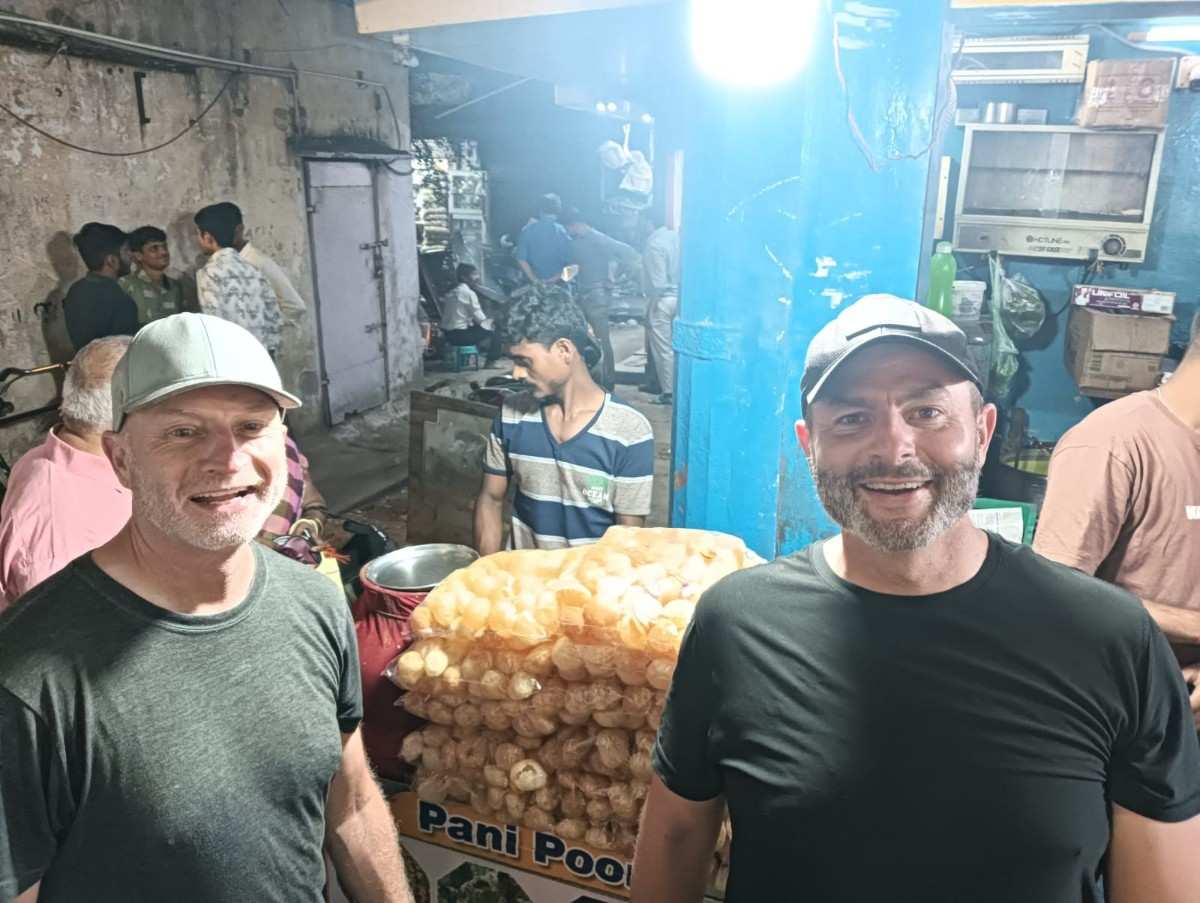
All food is included in the tour price. The walk covers pyaaz kachori at Maya Chats, the murukku sandwich, vada pav at Shree Vada Pav, kesar lassi at Anmol Lassi and aloo tikki with jalebi at Kakada Ramprasad, along with seasonal dishes and snacks that your guide will introduce along the way.
The walk begins at 4.30pm at the entrance to the Flower Bazaar Police Station. GPS coordinates for the meeting point are shared the day before. The walk ends at the same meeting point approximately two hours later.
Wear comfortable walking shoes. The lanes are narrow, the pavements are uneven and the walk requires navigating a genuinely busy working market. Come on an empty stomach. You will not leave hungry.
Book your Sowcarpet food walk with 5 Senses Walks today
The Best Time to Visit and Practical Tips for Your Chennai Food Walk
October to February is the ideal season for the Sowcarpet food walk, when Chennai’s temperatures are comfortable for walking and the evening atmosphere of the market is at its most vibrant. The monsoon months from October to December bring their own atmosphere to the lanes, with the rain intensifying the aromas and the vendors working with the particular focused energy of people who know the season is short.
Evening departures at 4.30pm are the definitive time to experience Sowcarpet. The wholesale traders have begun to wrap up for the day, the food vendors are at peak preparation and the light is at the golden quality that makes everything look more beautiful than it already is.
Carry small denomination cash. Digital payments are not accepted at the food stalls. A light jacket is useful in the cooler months as the evening temperature drops quickly after sunset. Leave your largest bag at the hotel as the lanes
are genuinely narrow and a bulky backpack becomes a significant obstacle in the most crowded sections.Extend Your Chennai Experience With 5 Senses Walks and 5 Senses Tours
The Sowcarpet food walk is the perfect beginning to a deeper exploration of Chennai’s extraordinary cultural layers. The city rewards curiosity at every turn and 5 Senses Walks has built expert guided experiences designed to reveal the Chennai that most visitors never find.
Our George Town heritage walk explores the neighbourhood that surrounds Sowcarpet, taking you through the ancient temples that predate the British era, the Armenian church built by traders who came to Chennai from the Caucasus and the full story of how George Town became one of Asia’s great trading crossroads. This walk pairs perfectly with the Sowcarpet food walk as a full day of George Town discovery.
Our Mylapore walk takes you into the heart of Chennai’s oldest temple neighbourhood, where the 7th century Kapaleeshwarar Temple, the tomb of St Thomas the Apostle and the philosophy of Ramakrishna Paramahamsa create one of the most culturally layered walking experiences available anywhere in India. The famous Mylapore filter coffee served during the walk is, in its own way, as extraordinary as anything you will drink in Sowcarpet.
For travellers who want to explore the broader heritage of Tamil Nadu beyond the city, our Chennai tours from 5 Senses Tours offer expert guided private experiences to Mahabalipuram, Kanchipuram, Pondicherry and the extraordinary three-temple Chola circuit that covers some of the most remarkable UNESCO World Heritage Sites in Asia.
Leave a Reply