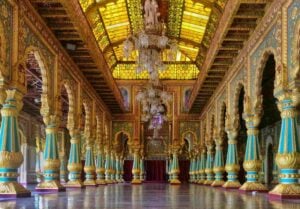
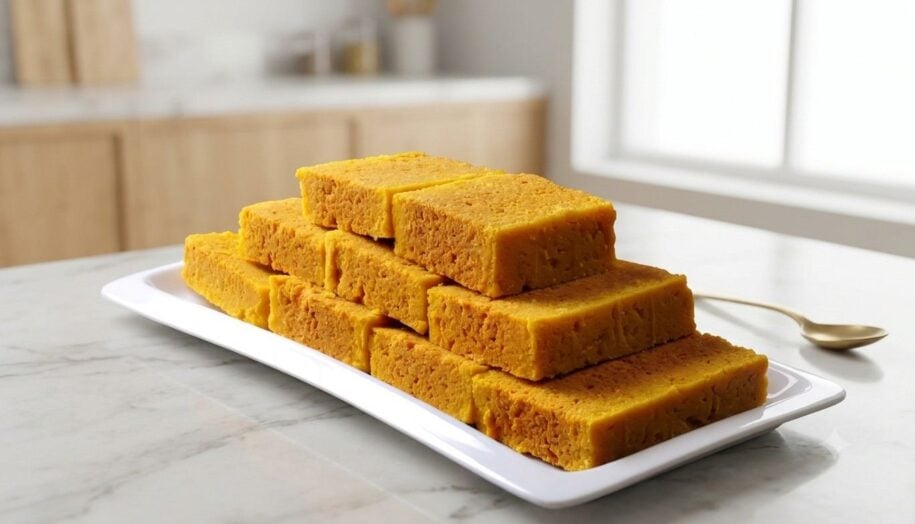
Mysore Pak is a rich sweet made from gram flour, ghee and sugar, traditionally credited to Kakasura Madappa, a cook in the royal kitchen of Maharaja Krishnaraja Wadiyar IV, who ruled from 1902 to 1940. The best known story says the king’s lunch had no dessert, so Madappa improvised. His descendants still run Guru Sweets in Mysuru, and the family says the word pak refers to sugar syrup. Accounts differ on the details, which is part of its charm. You can taste Mysore Pak at Devaraja Market on a three hour walking tour that also covers Mysore Palace and Jaganmohan Palace.
It has three ingredients and more claimants than a throne.
Gram flour. Ghee. Sugar. From those three humble things came one of the most famous sweets in India, a golden, buttery block that dissolves on the tongue and has crossed oceans, started political rows and been ranked among the best sweets in the world.
And no one can quite agree on how it began.
Here are four versions of the truth.
Version 1: The lunch that had no dessert
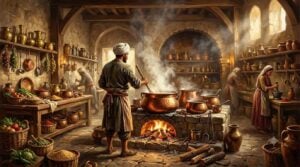
This is the story the family tells, and it is the best.
Krishnaraja Wadiyar IV, who ruled Mysore from 1902 to 1940, adored fine food. His kitchens in Amba Vilas Palace were so vast that they were divided by cuisine, with separate kitchens for European dishes and for the temple offerings made inside the palace.
One day, the story goes, his lunch was ready, but there was no dessert. A cook named Kakasura Madappa realised the mistake. He had no time. He reached for what was nearest, gram flour, ghee and sugar, and stirred them into a soft, warm, fudgy mixture. He served it on the royal thali.
The king loved it. He asked for a second helping. Then he asked what it was called. Madappa, according to the family, gave the first name that came to mind: Mysore Pak.
Version 2: The king who asked for something new
A second telling is quieter. In this version nobody panicked. The king simply asked his cook for something different, a sweet worthy of the kingdom, and a sweet named after it. Madappa answered with the one that bears the name of the city.
The two stories are not enemies. Both agree on the cook, the king and the three ingredients. They only disagree about whether the first batch was born of fear or of a royal request.
Version 3: The master of the sugar syrup
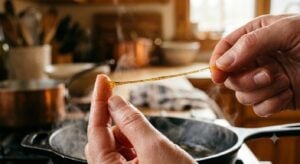
Look closely at the word pak, and a third version appears.
Madappa’s great grandson S Nataraj explains that pak comes from the Kannada word for the sugar syrup at the heart of the sweet. A cook skilled at making that syrup is called a nalapaka, and one account says Madappa earned that title in the palace for his calm precision with sugar.
That detail matters, because the whole secret of Mysore Pak lies in the syrup. Sugar is boiled with a little water until it reaches what recipes call one string consistency. Gram flour is roasted gently in ghee, the syrup is poured in, and the mixture is stirred without stopping until it leaves the sides of the pan. Then it is poured onto a greased plate and cut into squares. Get the syrup wrong, and the sweet is wrong. Perhaps that is why a master of the syrup was the one who gave it its name.
The family has also described pak as a fudge like mixture in Kannada, and either meaning points to the cooking, not to any country. The family also describes how the sweet changed. The earliest versions were said to be so rich in ghee that they melted almost at once. Today there are two broad kinds: a soft, melting kind, and a crumbly, porous kind that comes in firm blocks.
Version 4: The date that will not hold still
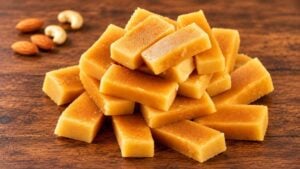
Ask when Mysore Pak was invented and the answers drift. Most accounts place it in the early twentieth century, during Krishnaraja Wadiyar IV’s reign. One says it was around ninety years ago. Another places it in the nineteenth century. The family’s story ties it to the king’s lifetime, so it can only be as old as his reign.
The shop has its own versions too. One account says Madappa started a small stall on Ashoka Road, and that it later moved to Sayyaji Rao Road. Another says the king asked him to open a shop outside the palace walls, and that he opened Guru Sweet Mart on Sayyaji Rao Road in 1957. A third, from the family, says it opened about sixty years ago along the route of the Dasara Jumbo Savari, the grand elephant procession that helped popularise the sweet.
Whatever the exact year, the family has stayed. Five generations have now learned to make it. A report from 2015 counted more than a thousand customers a day at the shop, about forty percent of them from outside Mysuru, and recalled admirers from film stars to a chief minister.
When a sweet becomes a headline
Mysore Pak has had more than its share of drama, and the stories say something about how much people love it.
In 2016, a joke meme about the sweet’s name went viral on social media. In September 2019, a columnist tweeted a mocking claim that the Geographical Indication tag for the sweet had been given to Tamil Nadu. Local media misread it as a real dispute between states. The family responded by saying it wanted official recognition, and applied for a GI tag of its own. The family said in 2025 that it was still waiting for a decision. Karnataka already had dozens of GI tagged products, 18 of them from Mysuru alone.
Then, in May 2025, amid tensions between India and Pakistan, some sweet shops in Jaipur renamed the sweet Mysore Shree to avoid the word pak. The family of the inventor was dismayed. S Nataraj said there could be no other name for the invention passed down by his ancestors, and he reminded people that in Kannada, pak refers to sugar syrup, not to any country.
The sweet has also been recognised abroad. In 2023 the food guide TasteAtlas ranked Mysore Pak 14th in its list of the world’s best street food sweets.
The Mysore Palace Walking Tour

The walk takes three hours on foot, starting at 2:30 PM at Mysore Palace and ending at about 5:30 PM in Devaraja Market. You spend about an hour and ten minutes in the palace, about forty minutes in the Jaganmohan Palace art gallery, and the rest of the afternoon in the market, finishing with the tasting.
Groups never exceed eight guests. A group walk runs on Saturdays and Sundays, and a private walk runs daily. On the private walk the guide, the palace entry tickets and the Mysore Pak tasting are included. On the group walk the guide and the tasting are included, and entrance charges are added according to nationality.
Frequently Asked Questions
According to tradition, Kakasura Madappa, a cook in the royal kitchen of Maharaja Krishnaraja Wadiyar IV. His descendants still run Guru Sweets in Mysuru. The story is a well known legend, and accounts differ on the details.
Gram flour, ghee and sugar, often with a little cardamom. Traditional versions are very rich in ghee.
According to the inventor’s family, pak is a Kannada word for sugar syrup, and a nalapaka is a cook who is skilled at making it.
Guru Sweets, in the Devaraja Market area on Sayyaji Rao Road in Mysuru, is run by the descendants of the cook and is widely known for its version.
Yes. Our three hour Mysore Palace Walking Tour ends at Devaraja Market with a Mysore Pak tasting.
To follow this story in Mysore itself, join our Mysore Palace Walking Tour. Karnataka has far more to offer, and our Coast to Canopy trail through coastal Karnataka and the Western Ghats is a good place to continue. Every 5 Senses tour is built to benefit the people who live along the route, and you can read how in our responsible tourism approach.
To plan a longer journey, talk to us about a custom itinerary.
A king, a cook and a lunch with no dessert. Whether or not every detail is true, the sweet is real, and it still tastes of the palace kitchen where it was born. Come to Mysore, and decide which version you believe.